Nicotine Withdrawal Timeline: Hour by Hour, Day by Day
The complete nicotine withdrawal timeline from hour 1 to month 6. When symptoms peak, when they fade, and what's happening inside your body.

Written by Abhishek · Founder, heycravo
Medical review pending · Our editorial standards
Most people who relapse do it within the first week. Not because they’re weak — because nobody told them what to expect at each stage.
When you know that hour 36 is harder than hour 12, that day 3 is the summit, and that the strange dip at day 10 is a documented neurological event — you stop interpreting difficulty as failure. You start seeing it as a map.
This is that map. Every phase of nicotine withdrawal, from the first hour to six months out, with the neuroscience behind why each stage feels the way it does.
| Phase | Timeframe | Dominant experience | Key finding |
|---|---|---|---|
| Onset | Hours 1–4 | Subtle restlessness; habit-driven thoughts | Nicotine at ~50% of peak |
| Sharpening | Hours 4–12 | Irritability, concentration loss, headache | Formal withdrawal onset (McLaughlin et al. 2015) |
| Night | Hours 12–24 | Disrupted sleep, REM rebound, appetite spike | Nicotine at trace levels |
| Wall | Day 2 | Intense cravings every 30–60 min, brain fog, anxiety | Dopamine at functional nadir |
| Summit | Day 3 | Peak symptoms; headache, nausea, mood crash | Nicotine fully cleared — Lindson-Hawley 2016 |
| Decline | Days 4–7 | Cravings less frequent; taste/smell returning | Receptor downregulation begins |
| Psychological | Weeks 2–3 | Day-10 mood dip; habit triggers active | Brief receptor rebound (Mamede et al. 2007) |
| Turning point | Month 1 | Mostly normal; 1–2 cravings/week | Receptors near baseline (Cosgrove et al. 2009) |
| Reset | Months 2–3 | Anhedonia lifts; reward system recovers | Dopamine synthesis normalises (Rademacher et al. 2016) |
| New normal | Months 3–6 | Rare craving flashes lasting seconds | Prefrontal grey matter recovering (Froeliger et al. 2019) |
How Nicotine Leaves Your Body
First, the pharmacology. Nicotine has a plasma half-life of approximately two hours (Benowitz et al., 2010, Handbook of Experimental Pharmacology). That means two hours after your last hit, half the nicotine in your bloodstream is gone. Four hours: 75% gone. By 72 hours, nicotine is undetectable in your blood.
But nicotine is only half the story. Your body converts nicotine into cotinine, a metabolite with a much longer half-life — roughly 16 hours. Cotinine is what drug tests detect, and it can linger for 1–10 days depending on how heavily you used (Cleveland Clinic, 2024).
The withdrawal you feel tracks the nicotine clearance curve. Symptoms start when levels drop, peak when the drug is fully cleared, and gradually fade as your brain recalibrates to function without it.
Hours 1–4: The First Whisper
What you feel: Subtle. A low-level restlessness. You think about smoking or vaping not because the craving is overwhelming, but because it’s habit time — after a meal, during a break, at the top of the hour. Your brain registers the absence before your body does.
What’s happening: Nicotine levels have dropped to roughly 50% of their peak. Your nicotinic acetylcholine receptors — upregulated by months of use — are starting to notice the supply is thinning. Dopamine output begins declining.
Survival note: This phase is deceptively easy. Don’t mistake it for “this isn’t so bad.” The storm is building.
Hours 4–12: The Edge Sharpens
What you feel: Irritability arrives. Concentration starts slipping. You might snap at something minor or find yourself reading the same email three times. A mild headache is common. You’re thinking about nicotine more frequently.
What’s happening: Nicotine levels have dropped below 25% of peak. The withdrawal syndrome is formally underway — McLaughlin et al. (2015, Pharmacological Reviews) documented symptom onset beginning at the 4-hour mark. Your brain’s GABA system (the brakes) is losing the nicotine-assisted boost. Glutamate (the accelerator) is running relatively unchecked.
Survival note: Drink water. Cold water activates your parasympathetic nervous system and blunts the irritability signal. This isn’t a metaphor — it’s physiology.
Hours 12–24: The Night
What you feel: Sleep is disrupted. You might fall asleep fine from sheer exhaustion, then wake at 2am or 3am with a racing mind. Dreams may be vivid or disturbing — this is REM rebound as your brain catches up on the deep sleep nicotine suppressed. Appetite is increasing. Emotional volatility is building.
What’s happening: Nicotine is now at trace levels. Carbon monoxide from smoking (if you smoked rather than vaped) has normalised — your blood oxygen levels are already healthier than they were 24 hours ago. But your brain doesn’t care about oxygen right now. It cares about dopamine, and the supply is dropping.
Survival note: The 24-hour mark is a significant psychological milestone. You’ve gone a full day. Millions of people have felt exactly what you’re feeling right now and come out the other side.
Day 2: The Wall
What you feel: Irritability intensifies. Brain fog is thick. Cravings are frequent and sharp — arriving every 30–60 minutes and lasting 3–5 minutes each. Anxiety spikes. You may feel physically restless — a need to pace, fidget, or move that you can’t quite satisfy. Food cravings, particularly for sugar, become strong.
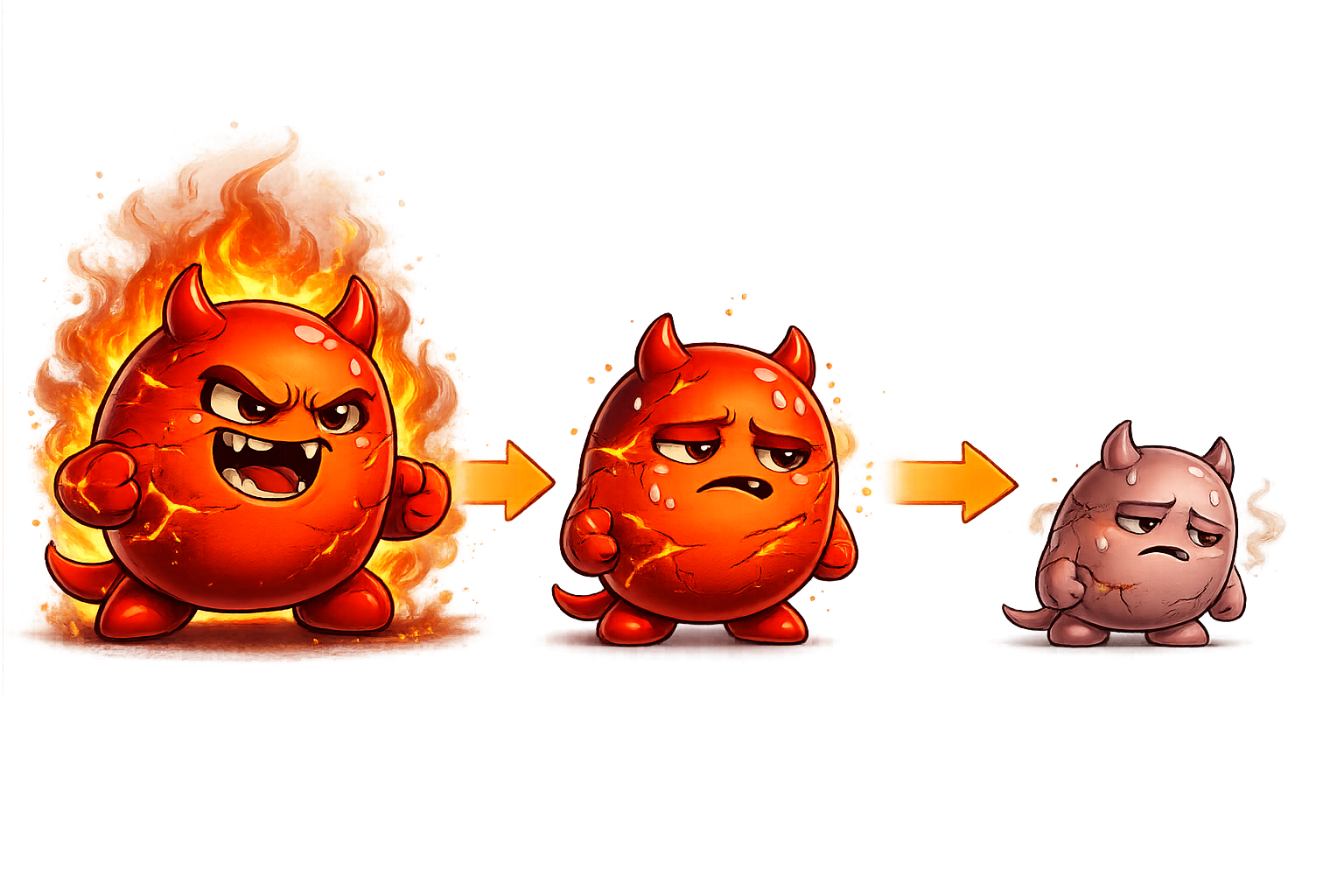
What’s happening: Cotinine (the long-lasting metabolite) is still being cleared. Your upregulated nicotinic receptors are fully unfed. Dopamine output in the nucleus accumbens has dropped to its lowest functional level. Your prefrontal cortex — the part of your brain responsible for impulse control and rational decision-making — is running on fumes because it relied on nicotine-enhanced acetylcholine signalling.
This is when Cravo is loudest. The craving will tell you this is permanent. It’s not. It’s biochemistry at its worst hour.
Survival note: Each individual craving lasts 3–5 minutes, then subsides. When one hits, look at a clock. Time it. Watching the wave crest and pass is evidence that the craving is lying about its own permanence.
Day 3: The Summit
What you feel: This is widely reported as the hardest day, and the data supports it. Cravings peak in both frequency and intensity. Emotional symptoms — anger, sadness, anxiety — hit their maximum. You may feel physically ill: headache, nausea, fatigue. Some people describe a “quitter’s flu” — body aches, low-grade malaise, sore throat.
What’s happening: Nicotine is fully cleared from your bloodstream. Every receptor that was built for nicotine is empty. This is the neurochemical bottom — the absolute lowest point for dopamine, the highest point for withdrawal distress.
But here’s what’s also happening: your lungs are already clearing mucus. Bronchial tubes are relaxing. Your nerve endings are beginning to regrow. And your brain has already started the process of receptor downregulation — dismantling the extra hooks that nicotine built.
The critical stat: The 2016 Lindson-Hawley study (published in Annals of Internal Medicine, covered by Harvard Health) found that cold turkey quitters who survived the first week had a 49% success rate at four weeks, versus 39% for gradual reducers. If you’re reading this on day 3: you are at the exact point where persistence pays off most.
Survival note: Day 3 is the summit of the mountain. Everything after this is descent.
Days 4–7: The Decline Begins
What you feel: Cravings are still present but less frequent — maybe a few per day instead of a few per hour. Brain fog starts lifting. Sleep may still be disrupted, but the acute insomnia is easing. Appetite remains elevated. You might notice your sense of taste and smell sharpening (particularly if you smoked).
What’s happening: Your brain is actively downregulating nicotinic receptors. The extra receptors built during addiction are being pruned. Dopamine production is starting to recover, though it’s still below baseline. Cilia in your airways are reactivating, beginning to sweep out accumulated tar and debris — which is why you may be coughing more, not less. This is healing.
Survival note: The danger zone shifts from physical withdrawal to psychological habit. You’ll reach for your pocket. You’ll pause at the time you’d normally step outside. These are cue-conditioned responses, and each time you experience the cue without acting on it, the association weakens.
Weeks 2–3: The Psychological Phase
What you feel: Physical withdrawal symptoms are fading significantly. But the mental game intensifies. Boredom feels harder to manage. Stress triggers the thought “I could really use one right now.” You might experience a surprising emotional dip around day 10–14 that feels like a step backward.
What’s happening: The day 10 dip is real and documented. A 2007 SPECT imaging study by Mamede et al. (Journal of Nuclear Medicine) found that nicotinic receptor binding briefly rebounds around day 10 before continuing to normalise. Your brain is recalibrating, and the process isn’t perfectly linear.
By day 21, receptor density is approaching non-smoker levels. The physical addiction is largely broken. What remains is the conditioned response — the habit loops, the emotional associations, the identity of being “a smoker” or “a vaper.”
Survival note: This is where the craving changes tactics. It stops screaming and starts whispering. “You’ve proven you can quit. One won’t hurt now.” This thought is more dangerous than day 3. One puff can re-sensitise your nicotinic receptors in minutes.
Month 1: The Turning Point
What you feel: Most days feel genuinely normal. Cravings are rare — maybe one or two a week, usually triggered by specific situations. Energy levels are stabilising. Sleep has normalised. You’re starting to taste and smell things you’d forgotten existed.
What’s happening: Nicotinic receptor density is at or near non-smoker levels (Cosgrove et al., 2009, Archives of General Psychiatry). Your brain’s acetylcholine system is producing its own supply without needing external nicotine. Lung function has begun measurably improving. If you smoked, circulation is noticeably better.
Survival note: The one-month mark is where most of the “normal life” benefits start compounding. You’ve also saved a meaningful amount of money. Check your savings →
Months 2–3: Dopamine Resets
What you feel: The flat, anhedonic feeling — “nothing is enjoyable” — is lifting. Music sounds better. Jokes are funnier. Exercise feels more rewarding. You’re starting to enjoy things for their own sake, not just as distractions from cravings.
What’s happening: This is the phase documented by Rademacher et al. (2016, Biological Psychiatry). The 15–20% dopamine synthesis deficit caused by chronic nicotine use fully normalises around the 3-month mark. Your reward system is yours again. The things that felt muted and grey are regaining their colour.
Survival note: If you’ve made it to month 3, your statistical probability of long-term success is dramatically higher. The biological addiction is over. What remains is habit management — and that’s a problem your conscious brain can solve.
Months 3–6: The New Normal
What you feel: Cravings are rare — perhaps once a month, usually triggered by a strong emotional event or an unexpected sensory cue (the smell of smoke, a specific location). They pass in seconds, not minutes. Your energy, mood, sleep, and focus have settled into a baseline that is genuinely better than your smoking/vaping baseline.
What’s happening: Neural pathway rewiring is well underway. The cue-craving associations that drove automatic reaching-for-the-vape behaviour are weakening through extinction. Grey matter density in the prefrontal cortex is recovering (Froeliger et al., 2019, Frontiers in Human Neuroscience). Cilia function is near-normal. If you smoked, your body’s healing continues for years.
A Note for Vapers
If you’re quitting vaping rather than smoking, the timeline above applies with some adjustments.
Nicotine salt formulations (used in JUUL, Elf Bar, and most disposable vapes) deliver nicotine faster and at higher concentrations than cigarettes. A 2021 study by Leavens et al. in Addiction found that e-cigarette users maintained cotinine levels equal to cigarette smokers. An academic analysis of r/QuitVaping (PMC 8576600, 2021) found that 38.33% of posters quit cold turkey, and most described the first 3 days as the hardest — consistent with the smoking timeline.
The key differences:
- Withdrawal onset may be faster — within 1–2 hours rather than 2–4, because nic salts clear quickly
- Cravings may spike harder but for shorter bursts — the tight cue-reward pairing from rapid delivery creates sharper but briefer urges
- The psychological dependence may be stickier — vaping has no natural stopping point (no cigarette “end”), so the habitual reaching-for-device behaviour runs deeper
The good news: the recovery timeline is comparable. Day 3 is still the summit. Month 3 is still the dopamine reset. The destination is the same.
The Enemy’s Strategy at Each Stage
Here’s what makes this timeline powerful: Cravo — your craving — has a predictable playbook at each phase.
- Hours 1–12: Subtle nudges. “You deserve this.” “Just one more day, then quit.”
- Days 2–3: Full assault. “You can’t do this.” “It’s too hard.” “This is permanent.”
- Weeks 2–3: The whisper. “You’ve proven your point. One won’t hurt.”
- Month 1+: Nostalgia. “Remember how good it felt?” (It didn’t. It felt like relief from the withdrawal that nicotine itself caused.)
When you know the playbook, the plays lose power. Name the tactic when it arrives. “That’s the ‘just one’ trick.” “That’s the nostalgia rewrite.” Naming it puts your prefrontal cortex back in charge.
That’s exactly what Cravo the app is designed to do — identify the tactic in real time and give you the counter-move.
Frequently Asked Questions
When is the hardest day of nicotine withdrawal?
Day 3 is consistently the hardest. Nicotine is fully cleared from your blood by 72 hours, and withdrawal symptoms — cravings, irritability, anxiety, brain fog — peak simultaneously. After day 3, symptoms begin declining.
How long does nicotine withdrawal last?
Acute physical symptoms last 2–4 weeks, with the worst concentrated in days 1–5. Psychological cravings persist longer but weaken steadily. Dopamine normalises by month 3. Most people feel completely free of withdrawal by 3–6 months.
Why do I feel worse at week 2 than week 1?
Around day 10–14, nicotinic receptor binding briefly rebounds (Mamede et al., 2007). This neurological recalibration can cause a temporary uptick in cravings and mood symptoms. It’s normal and passes within a few days.
Is the withdrawal timeline different for vaping vs. smoking?
The core timeline is similar — day 3 peak, month 3 dopamine reset. But vapers using nicotine salts may experience faster symptom onset (1–2 hours vs. 2–4) and sharper craving spikes due to the rapid delivery mechanism. Overall duration is comparable.
Does nicotine withdrawal get easier after the first week?
Dramatically. The first 3 days contain the worst of the physical withdrawal. Days 4–7 show marked improvement. By week 2–3, most physical symptoms are fading and the challenge shifts to managing psychological triggers and habits.
Can I speed up nicotine withdrawal?
You can’t accelerate the neurological timeline, but you can reduce symptom intensity. Exercise helps normalise dopamine. Hydration and fibre help with GI symptoms. Cold water physiologically interrupts craving signals. And knowing the timeline itself helps — research shows that expectation management improves quit outcomes.
“The secret of getting ahead is getting started.” — Mark Twain
This article is for informational purposes only and does not constitute medical advice. If you’re considering medication-assisted cessation, consult a healthcare professional.
Beat Your Craving
Your craving has a strategy.
Now you have one too.
Download Cravo — the app that fights cravings with you.
Download the App →