The Science of Habit Loops: Why You Reach for a Vape Without Thinking
Cue, routine, reward — your smoking habit runs on autopilot. Here's how the basal ganglia automates nicotine use, and how to reprogram the loop.

Written by Abhishek · Founder, heycravo
Medical review pending · Our editorial standards
You didn’t decide to smoke that last cigarette. Not really.
You were stressed, or bored, or your coffee was ready, or you’d just finished eating — and your hand moved before your brain caught up. The smoking habit loop fired, the nicotine habit executed, and you were three drags in before you consciously registered what you were doing. That’s not a lack of willpower. That’s neuroscience.
Every smoker and vaper knows this feeling: the eerie sensation that the craving acted for you. That you were a passenger in your own behaviour. And every quit attempt that relies on “just deciding not to” runs headfirst into this wall — because the part of your brain running the habit isn’t the part that makes decisions.
Understanding how habit loops work, specifically how nicotine exploits them, is one of the most useful things you can learn before your next quit attempt. Not because knowledge alone will save you. But because you can’t reprogram a system you don’t understand.
What Is a Habit Loop?
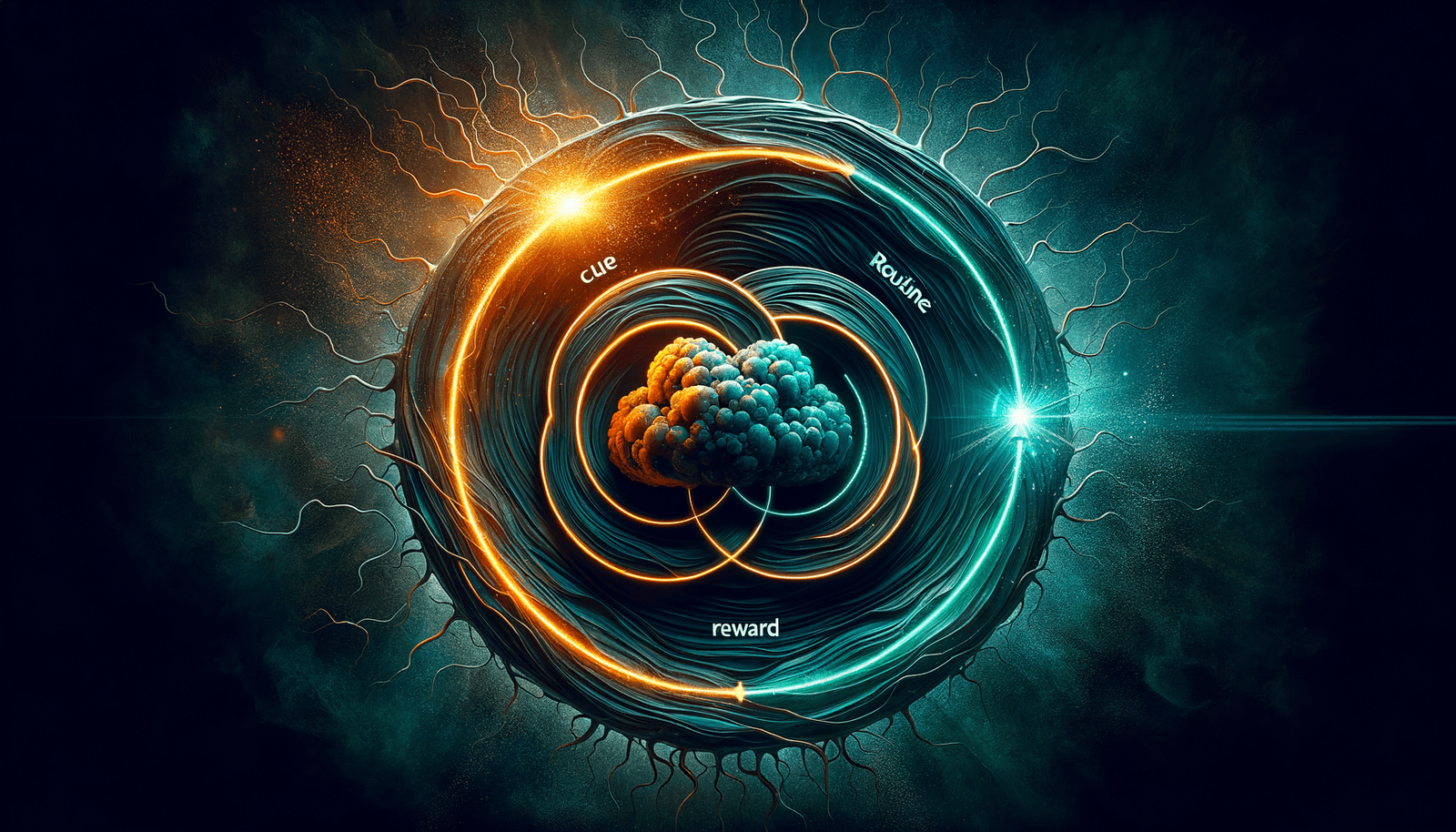
In 2005, researchers at MIT’s McGovern Institute published a landmark study in Neuron that mapped the neural architecture of habit formation. They found that habits follow a consistent three-part structure:
- Cue — a trigger that tells your brain to initiate the behaviour (a time of day, an emotion, a location, a preceding action)
- Routine — the behaviour itself (reaching for the vape, lighting the cigarette, stepping outside)
- Reward — the payoff that reinforces the loop (dopamine hit, stress relief, social belonging, the physical sensation of inhaling)
This cue-routine-reward cycle is the basic unit of habitual behaviour. It governs everything from brushing your teeth to checking your phone to smoking after meals. Charles Duhigg popularised the framework in The Power of Habit, but the neuroscience behind it stretches back decades.
The critical insight is this: once a behaviour is looped enough times, it stops being a decision. It becomes automatic. And the structure responsible for that automation lives deep in the centre of your brain.
The Basal Ganglia: Your Brain’s Autopilot
The basal ganglia is a cluster of nuclei sitting beneath the cerebral cortex. It’s ancient — evolutionarily, it predates the neocortex by hundreds of millions of years. And its primary job is to take repeated behaviours and convert them into automatic routines.
This is, in most contexts, extraordinarily useful. You don’t consciously think about how to walk, how to type, or how to drive a familiar route. The basal ganglia chunked those behaviours into automatic sequences so your prefrontal cortex — the conscious, deliberate part of your brain — could focus on other things.
A 1999 study by Jog et al. in Science demonstrated this process in rats learning to navigate a maze. During early trials, the entire brain was active — the rats were thinking hard about every turn. But as the behaviour became habitual, neural activity consolidated into the basal ganglia. The rest of the brain effectively went quiet. The habit had been “saved” as a programme that could run without conscious oversight.
The same process applies to smoking. The first few cigarettes of your life required conscious effort. You had to decide to buy them, figure out how to light them, push past the coughing. But after weeks and months of repetition, the basal ganglia absorbed the entire sequence. Now the cue fires, the routine runs, and you’re inhaling before your prefrontal cortex has weighed in.
This is why you can smoke an entire cigarette while having a conversation and barely remember doing it. The behaviour wasn’t running in your conscious mind. It was running in the basal ganglia — on autopilot.
Why Nicotine Is the Perfect Habit Drug
Not all habits are created equal. The strength of a habit loop depends on three factors: the consistency of the cue, the speed of the reward, and the frequency of repetition. Nicotine scores nearly perfectly on all three.
Speed of Reward
As covered in What Nicotine Does to Your Brain, inhaled nicotine reaches the brain in approximately 10 seconds. It triggers a dopamine release in the nucleus accumbens within moments. This is one of the fastest cue-to-reward intervals in all of pharmacology.
Why does speed matter? Because the basal ganglia strengthens associations based on temporal proximity. The closer the reward follows the cue, the stronger the wiring. A reward that arrives in 10 seconds creates a far tighter loop than one that takes 30 minutes. This is why nicotine patches, which deliver nicotine over hours, don’t produce the same addictive pull as smoking — the reward signal is too slow to reinforce the loop.
Frequency of Repetition
A pack-a-day smoker takes roughly 200 puffs per day. Each puff is a complete cue-routine-reward cycle. Two hundred repetitions, every day, for years. No other common substance produces this density of reinforcement. A heavy coffee drinker might complete 3–4 reward cycles per day. An alcohol user, 1–2. A smoker? Hundreds.
The basal ganglia doesn’t care about the magnitude of each individual reward. It cares about repetition. Two hundred small rewards per day will build a stronger automatic habit than one large reward per week. Nicotine’s modest-but-frequent dopamine spike — roughly 150% of baseline, compared to cocaine’s 300–400% — is actually what makes it so effective at habit formation. It’s not dramatic enough to be disruptive, but frequent enough to wire itself into everything you do.
Cue Proliferation
Here’s where it gets truly insidious. Because smoking happens dozens of times a day across varied contexts, the basal ganglia pairs nicotine with an enormous number of cues. Morning coffee. Post-meal. Stress. Boredom. Driving. Socialising. Walking to the train. Finishing a task. Before bed.
Each of these contexts becomes a trigger. And because the routine is always the same — inhale, get dopamine — the loop generalises across your entire life. You don’t have one smoking habit. You have dozens of smoking habits, each anchored to a different cue, all running through the same automatic pathway.
This is what Cravo — the craving — exploits. It doesn’t need to overpower you. It just needs to fire in enough situations that you’re never more than 20 minutes from a trigger. As we explored in Meet Your Craving, the craving isn’t a single enemy. It’s a pattern woven through your day.
Why Willpower Alone Fails
Every January, millions of people try to quit smoking through sheer determination. And the data is consistent: unassisted quit attempts — the “I’ll just stop” approach — succeed roughly 3% of the time at six months (CDC, 2022).
Three percent. That’s not a willpower problem. That’s a strategy problem.
Here’s why willpower is structurally mismatched against habit loops:
Willpower lives in the prefrontal cortex. Habits live in the basal ganglia. These are different brain systems with different properties. The prefrontal cortex is conscious, effortful, and depletable — it gets tired. The basal ganglia is unconscious, effortless, and tireless — it runs the same programme regardless of how exhausted you are.
Research by Baumeister and colleagues established that self-control operates like a muscle: it fatigues with use. A 2010 meta-analysis in Psychological Bulletin across 198 studies confirmed that after exerting self-control on one task, performance on subsequent self-control tasks deteriorated significantly. This is called ego depletion.
Now consider what happens during a quit attempt. Every cue that fires — and there are dozens per day — requires a conscious override from the prefrontal cortex. “No, I won’t smoke right now.” Each override depletes the resource. By mid-afternoon on day one, you’ve already burned through dozens of willpower events. By evening, you’re running on empty. By day three, when nicotine withdrawal peaks and your prefrontal cortex is biochemically impaired, the mismatch is overwhelming.
As we covered in Why Quitting Nicotine Is So Hard, withdrawal directly weakens the prefrontal cortex — the very system you need to override the habit. It’s not a fair fight. It was never designed to be.
How to Actually Reprogram a Habit Loop
The good news: habit loops can be rewritten. The basal ganglia is powerful, but it’s also programmable. The key insight from the research is that you rarely need to destroy a habit loop. You need to replace the routine while keeping the cue and the reward.
Step 1: Identify Your Cues
Before you quit, spend a week tracking when you smoke. Not just how many — when and why. Write down:
- What time was it?
- Where were you?
- What were you doing immediately before?
- What emotion were you feeling?
- Who were you with?
Patterns will emerge fast. You’ll find that 80% of your smoking happens in response to 4–5 specific cues. These are your primary targets.
Step 2: Design Replacement Routines
For each cue, choose a replacement behaviour that delivers a similar reward category. The replacement doesn’t need to match the nicotine hit — nothing will. It needs to address the psychological reward the smoking was providing:
- Stress cue → deep breathing, cold water on wrists, a 2-minute walk
- Boredom cue → chew gum, fidget toy, text a friend
- Social cue → hold a drink, step outside anyway but don’t smoke, change your position in the group
- Transition cue (finishing a meal, arriving at work) → create a new micro-ritual: specific song, specific stretch, specific app you open
The replacement must be immediate and physical. “Think positive thoughts” is not a replacement routine. “Put a cinnamon toothpick in your mouth” is.
Step 3: Ride the Extinction Curve
Every time a cue fires and you execute the replacement instead of smoking, the original loop weakens slightly. This process — called extinction — is well-documented in behavioural neuroscience. A 2016 review in Neuroscience & Biobehavioural Reviews by Bouton et al. confirmed that conditioned responses weaken progressively when the expected reward is withheld.
But extinction isn’t instant. The first 5–10 times a cue fires without nicotine will feel brutal. The basal ganglia expects the reward. When it doesn’t arrive, the craving intensifies — a phenomenon called an extinction burst. This is the moment most people relapse. Not because the strategy failed, but because they interpreted the increased craving as evidence that they can’t do it.
The extinction burst is actually a sign the loop is being challenged. It peaks and then declines. If you can survive the burst, the cue-craving connection weakens measurably each time.
Step 4: Stack the Deck With Pharmacology
Habit reprogramming works faster when combined with evidence-based cessation support. Nicotine replacement therapy (NRT) reduces the dopamine deficit that makes the extinction period so painful. Varenicline (Champix/Chantix) partially stimulates the same receptors, dulling both the craving and the reward if you do smoke.
The combination of behavioural habit replacement and pharmacological support roughly triples success rates compared to willpower alone. You’re not cheating by using medication. You’re addressing two systems simultaneously: the prefrontal-cortex-level decision and the basal-ganglia-level automation.
The Timeline of Loop Dissolution
Habit loops don’t dissolve overnight, but they do follow a predictable arc:
- Days 1–3: Highest cue reactivity. Every trigger fires at full strength. This is the acute withdrawal window where both neurochemistry and habits are working against you simultaneously.
- Weeks 1–3: Cue reactivity begins declining. You’ll notice some triggers losing their punch — particularly the weaker, less frequent ones (e.g., “smoking while waiting for the bus”). The major cues (post-meal, morning, stress) persist longer.
- Months 1–3: The basal ganglia pathways are weakening measurably. Dopamine synthesis is recovering to baseline (Rademacher et al., 2016). Cravings shift from constant to episodic. You’ll have stretches of hours where you don’t think about smoking at all.
- Months 3–6: Most cue-triggered cravings have faded. Occasional strong cravings may fire in response to unusual triggers — a specific location you haven’t visited since quitting, high stress, alcohol. These are remnant associations and they extinguish quickly with one or two unreinforced exposures.
The loop was built over thousands of repetitions. It won’t vanish in a week. But it will thin, weaken, and eventually go silent.
What Cravo Knows About Your Loops
This is what makes the craving so effective: it doesn’t need you to want a cigarette. It just needs the cue to fire and the routine to execute before your conscious mind intervenes. The craving operates below the level of decision-making, in the ancient, automatic circuitry of the basal ganglia.
That’s why the craving feels like something separate from you. In a very real neurological sense, it is. The habit loop runs in a brain system that doesn’t consult your goals, your health knowledge, or your reasons for quitting. It sees the cue, it runs the programme.
But here’s what the craving doesn’t know: the programme can be overwritten. Every unreinforced cue weakens it. Every replacement routine rewires it. Every day without nicotine allows the receptor landscape to normalise. The craving is powerful, but it’s also mechanical — and mechanical systems can be reprogrammed.
That’s what Cravo the app is built to help you do. Not to ignore the craving, but to see the loop for what it is, interrupt it in real time, and replace it with something that actually serves you. See how much your loops are costing you →
Frequently Asked Questions
What is a habit loop in the context of smoking?
A habit loop is a three-part neurological cycle — cue, routine, reward — that drives automatic behaviour. For smokers, the cue might be stress, finishing a meal, or a time of day. The routine is smoking. The reward is the dopamine hit plus the psychological relief. After enough repetitions, the basal ganglia automates this cycle so it runs without conscious decision-making.
Why can’t I just use willpower to break the smoking habit?
Willpower is managed by the prefrontal cortex, which fatigues with repeated use (ego depletion). Habits are managed by the basal ganglia, which doesn’t fatigue. A smoker faces dozens of cue-triggered urges per day, each requiring a conscious override. Nicotine withdrawal simultaneously impairs the prefrontal cortex, making each override harder. The 3% unassisted quit rate reflects this structural mismatch.
How long does it take to break a nicotine habit loop?
The acute neurochemical withdrawal peaks in the first 3 days. Cue reactivity begins declining within 1–3 weeks as receptor levels normalise. Most habit-driven cravings lose significant power by 1–3 months, with occasional cue-triggered cravings fading over 3–6 months. The often-cited “21 days to break a habit” is a myth — for nicotine, the timeline depends on the strength and frequency of individual cue-routine-reward loops.
What is an extinction burst and why does it matter for quitting?
An extinction burst is a temporary increase in the intensity of a behaviour when the expected reward is withheld. When you don’t smoke in response to a cue, the basal ganglia initially amplifies the craving signal — “try harder.” This feels like the craving getting worse, and it’s the point where many people relapse. Understanding that the burst is temporary and actually signals the loop is being challenged can help you push through rather than give in.
Can I replace smoking with a healthier habit?
Yes — and research suggests this is more effective than simply trying to stop. The key is matching the replacement to the reward category the smoking provided. If smoking relieved stress, the replacement should address stress (deep breathing, physical movement). If it relieved boredom, the replacement should provide stimulation. The cue stays the same, but the routine changes. Over time, the new routine becomes the automatic response.
Does nicotine replacement therapy interfere with habit loop reprogramming?
No — it supports it. NRT reduces the dopamine deficit that makes the extinction period painful, allowing you to focus on the behavioural reprogramming without the full force of neurochemical withdrawal. Think of it as lowering the difficulty while you rewrite the loops. The habit work and the pharmacological work address different systems (basal ganglia and neurochemistry, respectively) and are more effective in combination.
“We are what we repeatedly do. Excellence, then, is not an act, but a habit.” — Will Durant, summarising Aristotle
This article is for informational purposes only and does not constitute medical advice. If you’re considering nicotine replacement therapy, varenicline, or other cessation medications, consult a healthcare professional.
Beat Your Craving
Your craving has a strategy.
Now you have one too.
Download Cravo — the app that fights cravings with you.
Download the App →