The stress spiral: why Cravo thrives when your life falls apart
7 min read·Declassified April 2026
Cravo speaking
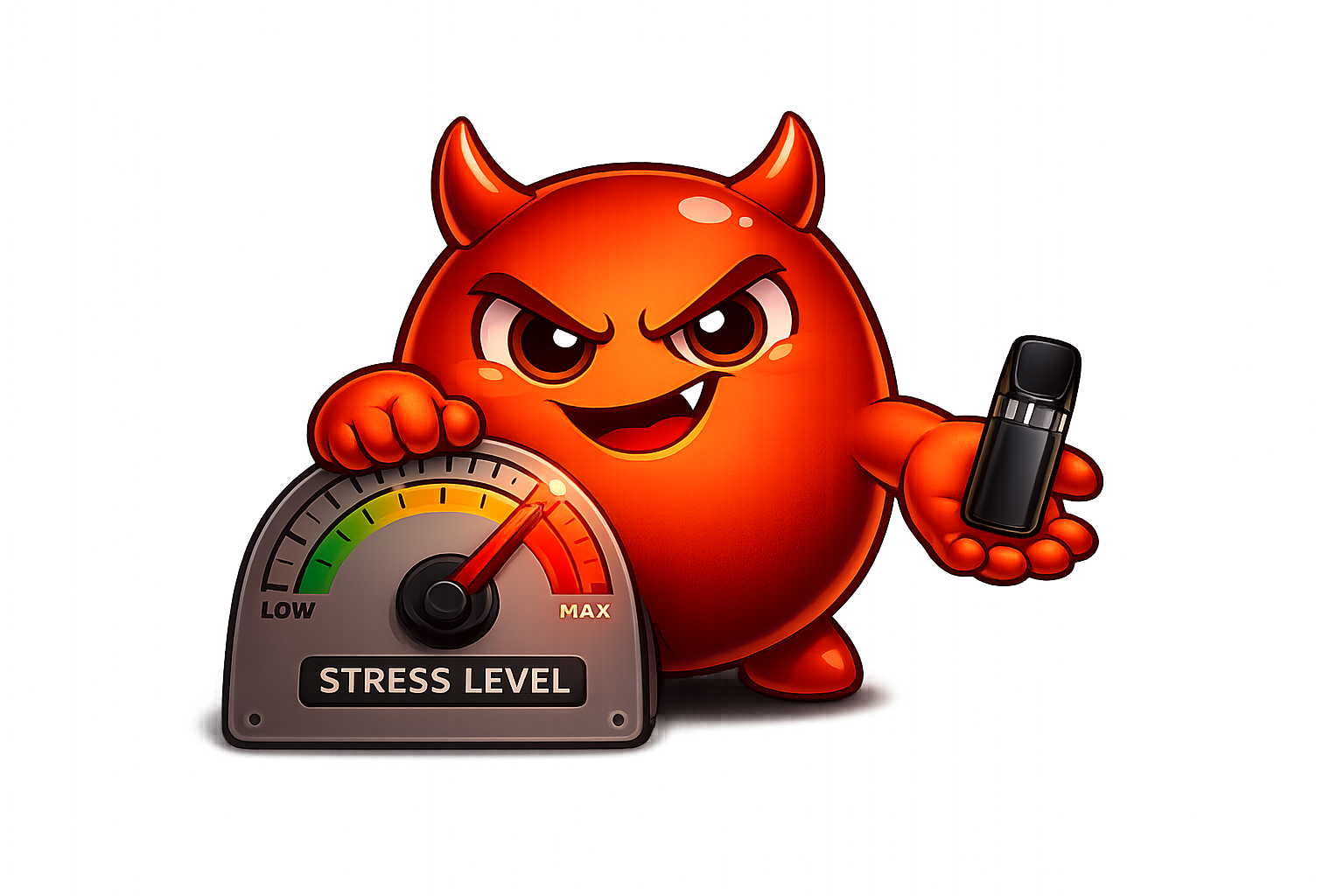
“A stressful week is a recruitment drive for me. I don’t even need to show up — you’ll come looking. Your boss shouts at you, rent goes up, your relationship wobbles, and the first thing your brain reaches for is the thing I trained it to reach for. I didn’t invent the stress. I just made sure I was the only button within arm’s reach when it hit.”
Why stress is my best weapon
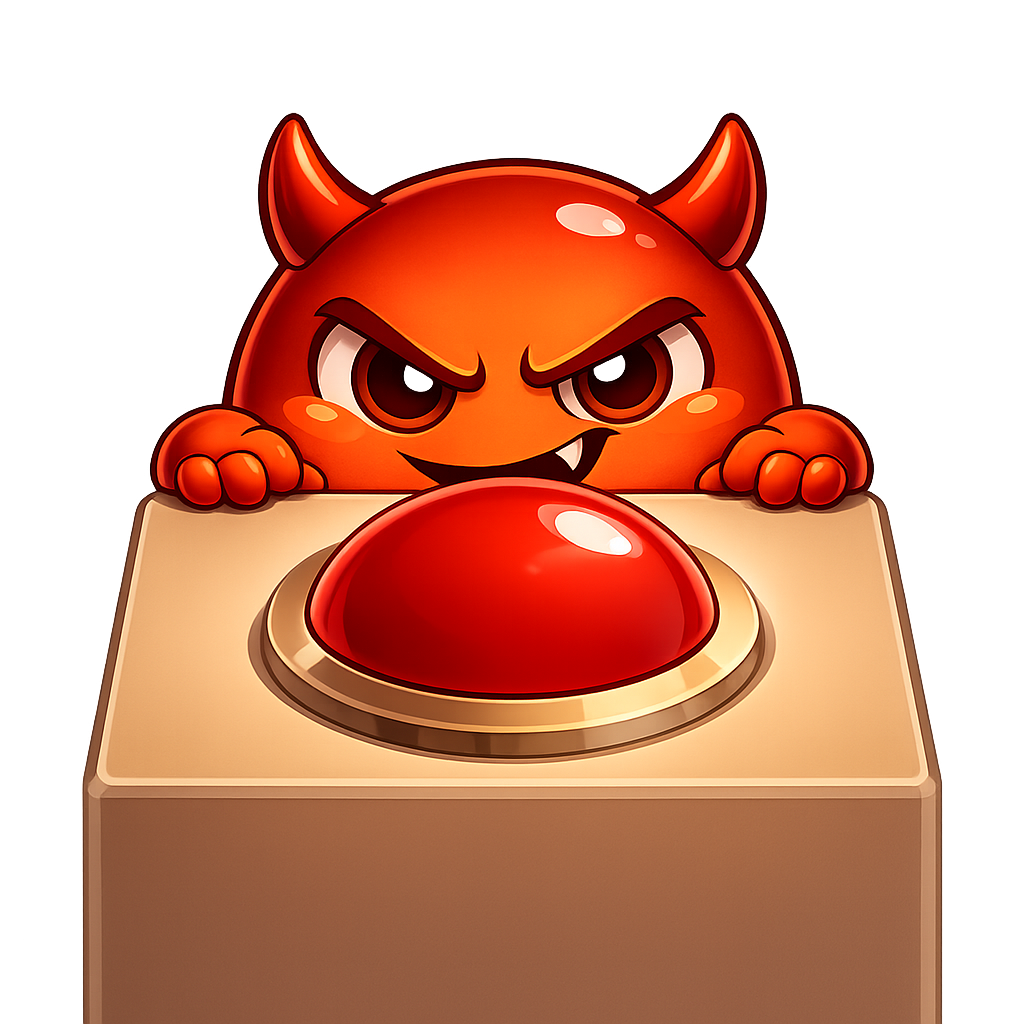
Most people assume stress causes vaping because nicotine calms them down. That’s the story the industry sold you, and it’s the story your own brain will repeat under pressure. It’s also, pharmacologically, not true.
Here’s what actually happens. Chronic stress floods your system with cortisol. Cortisol pushes your brain into short-time-horizon mode — it stops caring about long-term rewards and starts demanding immediate relief. In this state, your reward system gets impatient. It stops asking “what would feel good in a year” and starts asking “what would feel good in ninety seconds.”
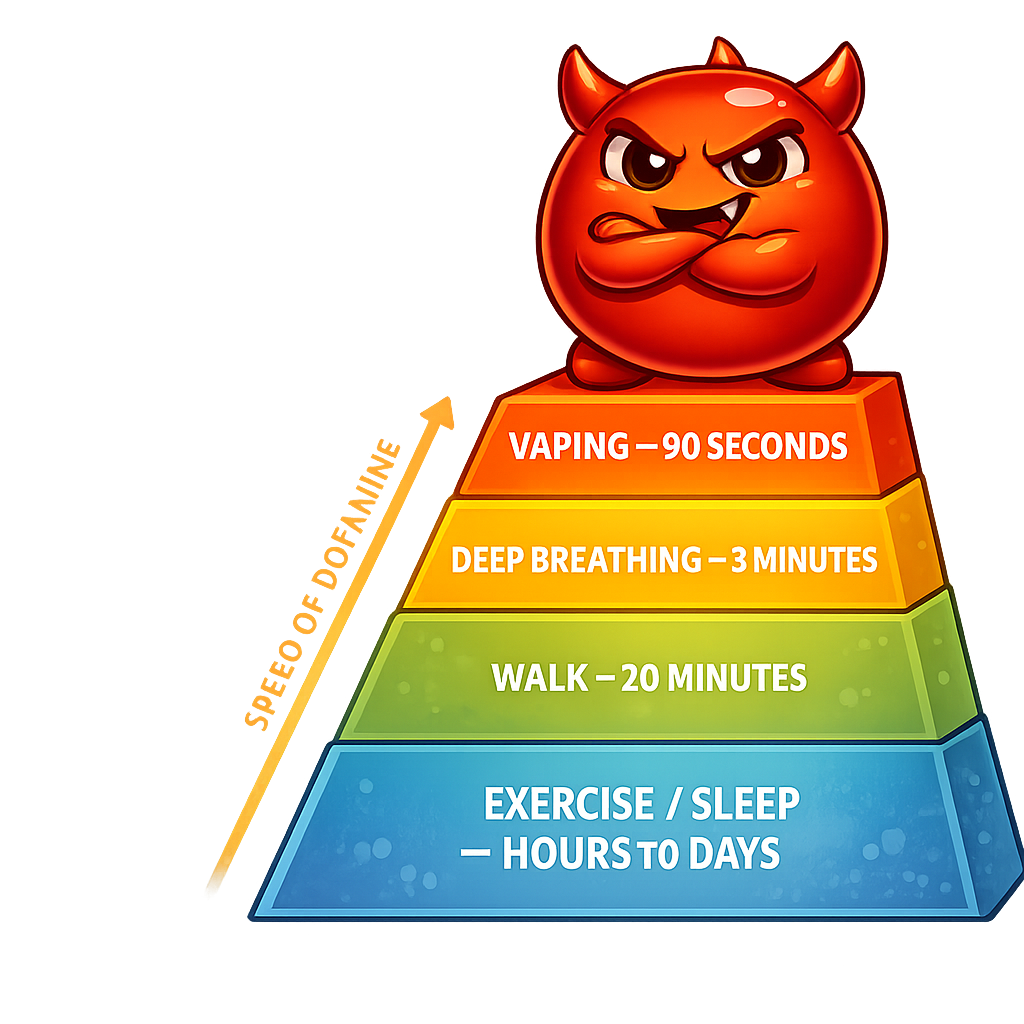
Ninety seconds is the answer I built a whole business around. That’s roughly the time from “I’m stressed” to “nicotine hits the brain” via a vape. Nothing else in your life is engineered to respond that fast. Exercise takes twenty minutes. A conversation takes a phone call. Sleep takes hours. I take ninety seconds.
Your stressed brain doesn’t evaluate options on quality. It evaluates them on speed. I win on speed every time.
How I hijacked your stress response
The hijack has three layers, and they’re wired in at different depths.
Conditioning. Every time you vaped when stressed — and then felt the brief rush of dopamine — your brain logged the sequence as cause and effect. After enough repetitions, the sequence runs automatically. Stressed → device. You don’t decide. Your basal ganglia decide before the rest of you catches up.
Expectation. Once the conditioning is in, even the anticipation of vaping starts to release dopamine. Just thinking about your device during a stressful moment produces a small relief response. That’s why putting it in your hand can feel soothing before you even inhale. It’s also why removing it creates real discomfort — you’re removing an anticipatory relief signal that your nervous system was counting on.
Attribution. The brain needs an explanation for why it felt better after vaping. It doesn’t have direct access to its own dopamine systems, so it makes up a story: “The nicotine helped me relax.” That story is wrong but sticky. It becomes your conscious belief. You will defend it in arguments. You will teach it to other people. You will write it on forums. And all it is, is the brain narrating the chemistry it doesn’t fully understand.
Together, these three layers explain why “I vape to relax” feels so true even though the pharmacology shows the opposite.
The relief myth, explained
Here’s the part I really don’t want you to read.
Nicotine is a stimulant. It raises your heart rate. It increases cortisol. It constricts blood vessels. It tightens jaw muscles. Pharmacologically, the molecule itself adds stress to your system.
So why does vaping feel like relief?
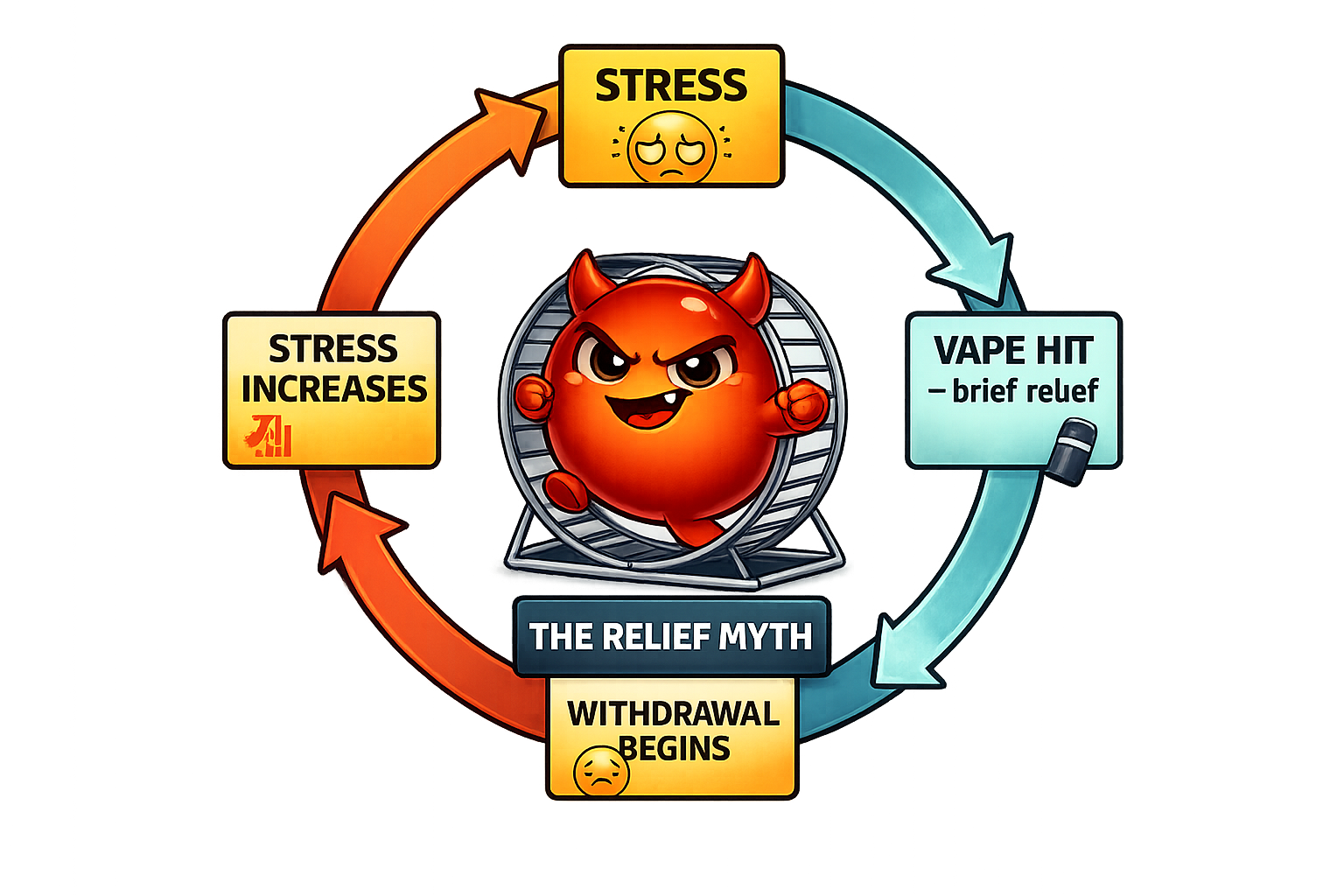
Because the withdrawal between doses feels worse than the baseline the drug created. When you vape, you’re not getting lifted above your normal state. You’re being returned to a temporary illusion of “normal” from a withdrawal state the previous hit induced. The relief is real, but it’s relief from the damage the previous dose caused — not from the original stress you thought you were treating.
Studies following smokers and vapers longitudinally show the same pattern: their baseline stress levels, measured between hits, are higher than people who don’t use nicotine at all. Not lower. Higher. The relief you feel is the gap between “in withdrawal” and “briefly not in withdrawal.” That gap is what I sold you as stress relief.
If you quit for long enough, your baseline stress drops to a level most current vapers would find unimaginable. You don’t miss the hits because there’s nothing left to dull.
But in the first few weeks, that information is useless. Because your baseline is still the distorted one. Quitting feels like adding stress — because you’re removing the drug that was partially masking the stress the drug itself was creating. That’s the cruel geometry of the trap. The only way out is through the part where it feels worse.
Cravo speaking
“The moment someone figures out that I’m the cause of their stress and not the cure, my business model collapses. I spend a lot of effort making sure that moment takes as long as possible to arrive. Articles like this one are, frankly, catastrophic for my numbers.”
The specific stressors Cravo targets
Different stressors create different openings. I’ve optimised for the ones that produce the strongest cravings.
Chronic under-recovery. Not acute stress — the low-grade “I’ve been running on empty for weeks” kind. Your prefrontal cortex gets depleted, your impulse control drops, and the instant-relief switch becomes dominant. This is why burnout is my peak season.
Financial pressure. Money stress produces a specific kind of tight, looping anxiety that the brain desperately wants to interrupt. Vaping gives the interruption. That the vaping costs money and deepens the financial stress is a detail your stressed brain doesn’t compute in the moment.
Interpersonal conflict. Fights, tense conversations, awkward social dynamics. These create a surge of cortisol and adrenaline that the body wants to discharge somewhere. Vaping becomes the discharge. The relief is purely about giving your nervous system something to do with the energy — not about the nicotine.
Sleep deprivation. A single night of bad sleep increases nicotine craving measurably the next day. Tired brains are short-time-horizon brains. Short-time-horizon brains reach for the fastest dopamine they can find. That’s always going to be me.
Uncertainty. Waiting on a result — medical test, job interview, relationship outcome. Uncertainty is cognitively expensive. Vaping doesn’t reduce the uncertainty but it does reduce the felt cost of sitting with it. Temporarily. And then I demand the next hit.
How to stop feeding the spiral
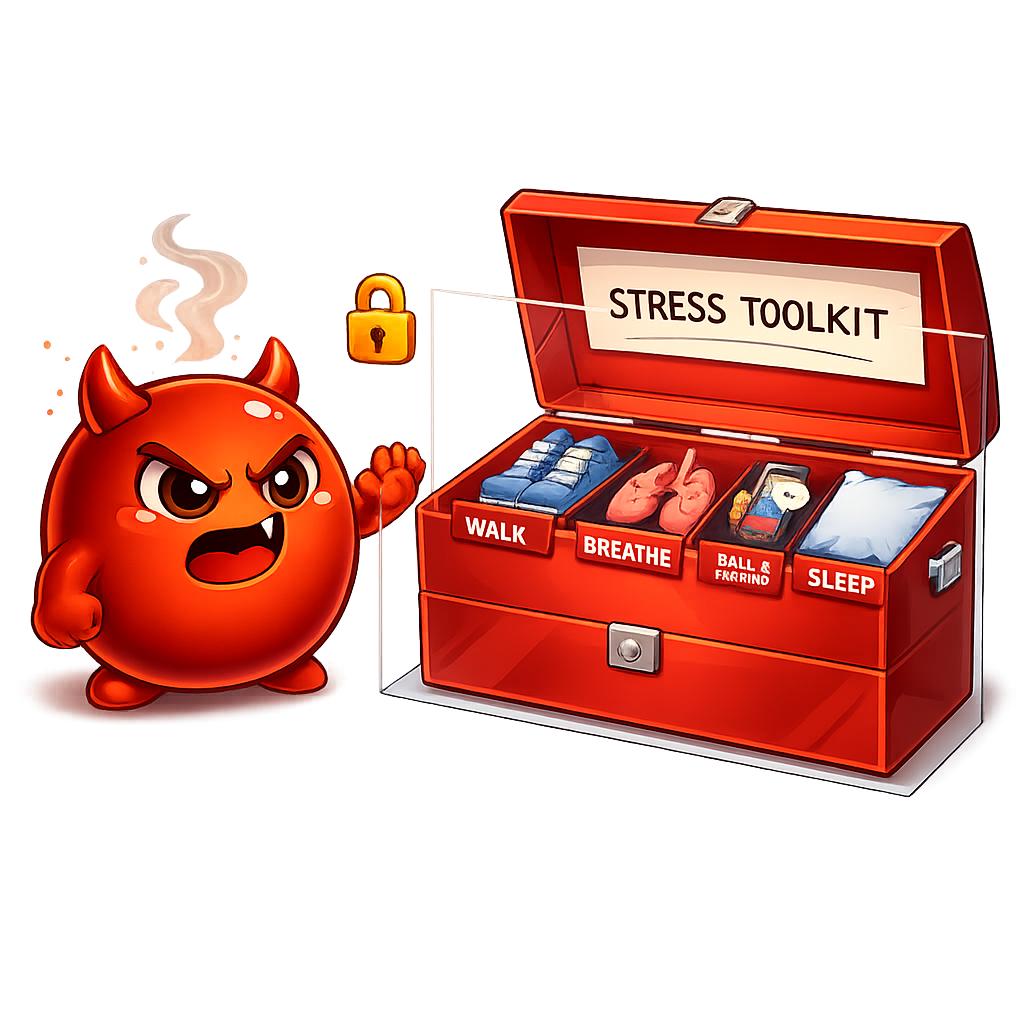
Build a non-nicotine stress circuit before you need it. The problem isn’t that you have no alternative to vaping. The problem is that your alternative isn’t wired to trigger automatically when stressed. Deliberately practice a specific response — box breathing, a two-minute walk, a specific person you text — when you’re calm. Repetition during calm builds the circuit. When the stress hits, the alternative now exists as a reachable default. Without this, “just use coping strategies” is advice you’ll never act on under pressure.
Recognise the 90-second tell. The most intense part of a stress craving usually peaks and breaks within 90 seconds — if you don’t feed it. If you do feed it, it becomes the permanent loop. Learn what 90 seconds feels like. Time it once. The peak always fades.
Name the attribution. When the “I need to vape to handle this” thought arrives, catch it. Say out loud: “This is the attribution error. The nicotine isn’t handling it. I’m handling it, and the nicotine is taking credit.” Sounds silly. Works.
Reduce chronic load, not just acute cravings. If you’re in a sustained high-stress life phase, no quit strategy will hold without reducing the underlying load. Sleep. Protect time. Say no to things. Cut scope somewhere. A quit attempt layered on top of a maxed-out life is a quit attempt designed to fail — because I’ll win on speed every time your system is depleted.
Don’t quit alone in a crisis. The single best predictor of successful quit attempts during stressful periods is having a specific person to contact when the craving hits. Not “a support network.” A named person. One text, one call. The act of externalising the craving breaks my isolation tactic. Decide who that person is now, before the next bad week.
Cravo speaking
“If you build a stress response that doesn’t include me, you don’t just stop using me — you start noticing that I was the source of half the stress. At that point I’m not your medicine. I’m your liability. And liabilities get cut.”
The stress that doesn’t need me
Here’s what the first stress-free-of-Cravo month actually feels like.
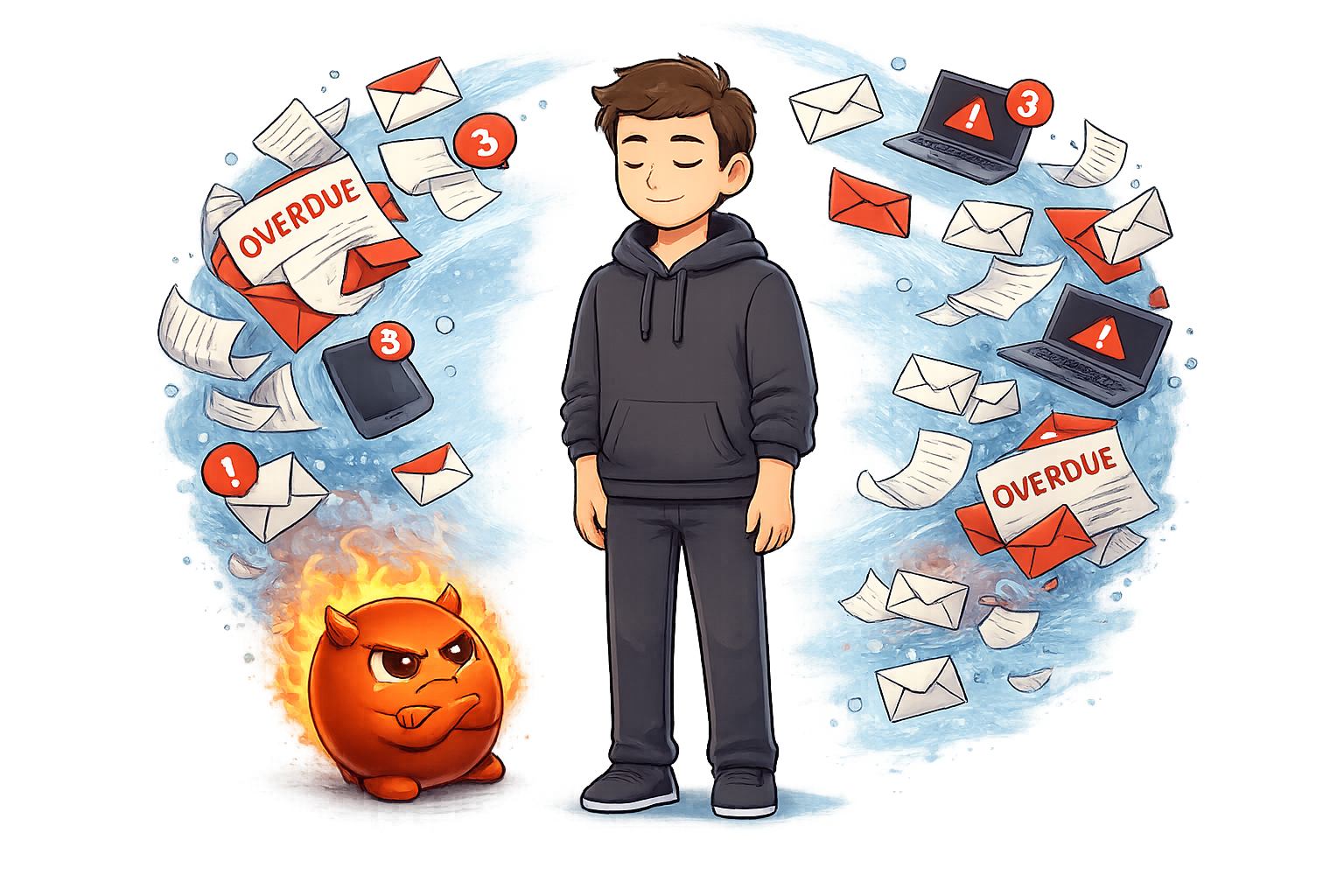
The stress doesn’t disappear. Your job is still hard. Your rent is still due. Your relationships still have the same wrinkles. What changes is the shape of the stress curve. Stressful moments still spike — but they also fall. They don’t stay elevated at a low-grade hum between hits.
Your mornings are quieter. Not because life got easier but because you’re not starting each day in mild withdrawal. Your evenings don’t need a wind-down cigarette because your nervous system isn’t stuck in sympathetic overdrive. Small annoyances feel like small annoyances, not triggers. A bad meeting is just a bad meeting — not a queued-up craving waiting to fire.
You find out that a lot of what you thought was “life stress” was actually “nicotine stress wearing life’s clothes.” Life was never quite as bad as I made it feel. I just wouldn’t let you see it without me in the frame.
The stress is still yours. But now, so are the tools.
Ready to fight back?
Stress is Cravo's favourite trigger. The Cravo app gives you real-time tools so the next bad day doesn't cost your quit.